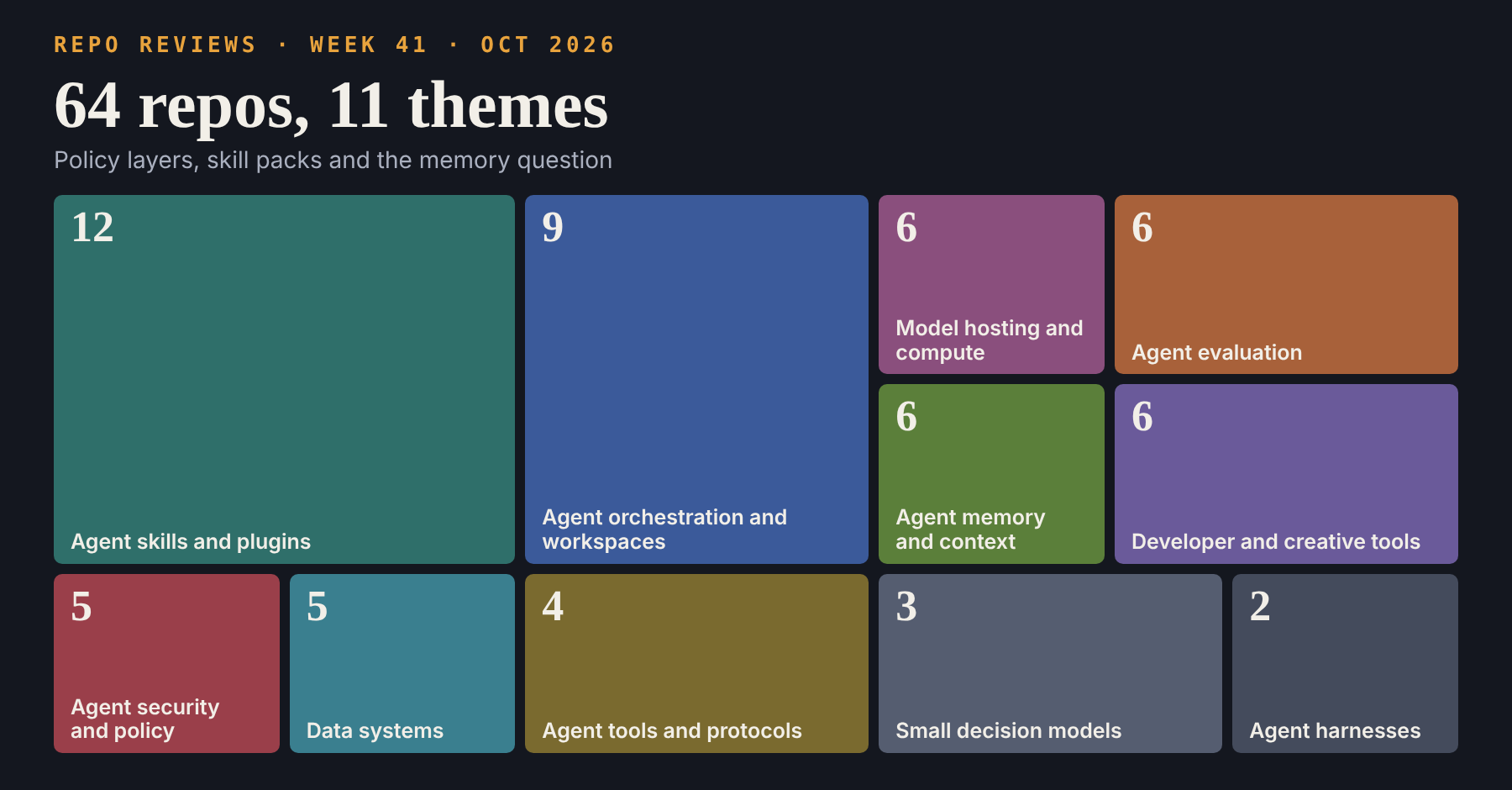
Three threads ran through this week’s reviews. The Dogwood cluster (a policy language, a durable engine, and a sandbox that embeds both) gave the Agent security and policy theme its most complete picture yet of stateful authorization. The skills wave added domain packs for animation, UX, business methodology, and engineering workflows to Agent skills and plugins. And Agent memory and context got three repos that disagree sharply on how to store what an agent needs to remember.
Agent evaluation
CommerceAgentBench adds 107 long-horizon commerce tasks (product publishing, freight booking, storefront operations) running against stateful local mock services, where a task passes only when every verifier check clears against actual state changes. aws-bench provisions real, isolated AWS accounts, deploys CDK stacks, runs the agent with scoped credentials in a container, and scores against live cloud state or an LLM judge. eval holds model, tasks, and runtime constant across nine coding-agent harnesses to measure harness-level effects on pass rate, cost, and cache behavior, finding a 17.5x cost spread at similar pass rates. jevbench scores decision models on four explicit axes: chance-corrected accuracy, calibration error, log-scale latency, and cost per 1,000 decisions (not per 1,000 tokens). SwarmWorld measures collective technological evolution in multi-agent societies, with deterministically replayable traces and counterfactual contributor-removal. faibench_frontier_infrabench targets ML systems work specifically: 85 Docker-reproducible tasks covering CUDA kernels, distributed training, vLLM serving, quantization, and MoE routing, each graded offline.
Agent harnesses and frameworks
tardigrade derives durable agent state from an immutable event log through composable atoms, running on Cloudflare Workers or Celld. paper points to a preprint that gives the formal calculus behind Cordis, grounding dynamic component composition in revertible effects and reactive coeffects with a metatheory showing components can interleave without disturbing each other.
Agent memory and context
strands-dynamodb-storage maps the Strands Agents SDK’s key contract onto DynamoDB partition-plus-sort keys, with optional vector search, TTL expiry, and S3 offload for oversized values. context-language-models gives the model unrestricted write access to its own context window as a file, then improves that behavior with evolved natural-language instructions or online RL. recur detects repeated questions and compiles them into typed dataflow programs via best-first search over a small IR, so subsequent answers run in under a millisecond with no model call. trajectory parses raw session transcripts from 15 agent runtimes into a single schema-validated record format for training, evaluation, and inference. OptMem stores memories as fixed-width append-only lines in a plain text log with a binary tree of summaries built on top, no external dependencies. OpenViking structures all context as a navigable filesystem under viking:// URIs with three-tier summaries and scoped semantic search.
Agent orchestration and workspaces
OpenResearch adds literature grounding against alphaXiv, bioRxiv, and PubMed so agents form hypotheses from current papers, and records every experiment in a local SQL database agents can read before deciding what to try next. sample-agentic-platform offers two concrete compute paths, EKS with Helm or ECS plus Bedrock AgentCore Runtime, sharing the same agent interface and gateway layer across 25+ lab notebooks. sample-agentic-value-accelerator covers the full agent lifecycle from DCF business-case models through compliance checklists for 14 frameworks, surfaced in a React/FastAPI control plane on ECS Fargate. buzz puts agents and humans in the same signed Nostr event log, so every message, patch, CI result, and workflow step lands in one searchable audit trail. OpenDots gives each agent its own isolated browser and file workspace that persists across restarts, with a human-in-the-loop approval step on document edits. loom derives every REST route, MCP tool, CLI command, and authority boundary from one Rust declaration per operation, so the server, CLI, and MCP adapter cannot disagree. overmind closes the loop from live trace collection through dataset curation, fine-tuning, and OpenAI-compatible inference serving in one platform. c11 makes every panel of a macOS terminal multiplexer scriptable over a socket so agents can split areas, spawn sub-agents, drive an embedded browser, and broadcast status to a shared sidebar. superset wraps any CLI coding agent in a desktop IDE with per-worktree browser previews, a diff viewer, scheduled automations, and an MCP server that lets agents create and manage their own workspaces.
Agent security and policy
dogwood extends Cedar’s permit/forbid syntax with temporal predicates (formerly, since, windowed aggregations) so policies can reason over an agent’s recent event history, not just the current request. dogwood-local-engine ingests events one at a time instead of processing a complete trace at once, checkpoints state to disk, and resumes correctly after a crash. box embeds the Dogwood local engine in an OS-level sandbox so a file read through one interpreter can block a later network request, and injects credentials into permitted outbound calls without exposing secrets to the agent process. automated-security-helper orchestrates Bandit, Checkov, Semgrep, Grype, and others in one pass, normalizes findings into SARIF/JSON/HTML, and exposes the whole pipeline as an MCP server for coding agents. threat-modeling-mcp-server structures STRIDE threat modeling into nine phase-gated steps with completion checks before export.
Agent skills and plugins
tastemaker grounds UI taste in runnable Python scripts (contrast checker, palette generator, anti-slop scanner) and writes decisions to local lock files so constraints persist across sessions. skills encodes specific aesthetic judgments about animation curves and motion performance as discrete, installable Markdown skill files. iso-24495 adapts plain language principles into agent-readable skill files and a rule engine that audits Markdown against measurable criteria: sentence length, paragraph length, legalese, heading depth, and undefined acronyms. ideonomy-skill draws from 36 operators, 25 organons, and 29 dimension prompts with a local Bash picker, producing a different method combination on each invocation with no network call. skills ships small, composable skill files each covering one engineering job. ideonomy-engine applies 28 named reasoning lenses to a problem statement, generating structured questions rather than answers, with profile-based lens selection and cross-lens synthesis. superpowers bundles an end-to-end development workflow from requirements brainstorming through subagent-driven task execution and TDD enforcement, with skills that fire in sequence. designer-skills encodes UX and visual design judgment as 111 skills across 9 plugins, covering research methods, design system tokenization, and heuristic evaluation. skills translates the Minimalist Entrepreneur framework into ten sequenced Claude Code commands.
Agent tools and protocols
ard-spec defines a domain-anchored, federated discovery layer so agents can find MCP servers, A2A agent cards, and other callable resources across networks of discovery services. at_mcp gives an agent ownership of credentials, session, and a write quota on the AT Protocol, so it holds a persistent Bluesky or Delvetown identity across runs. pwc-cli ships three interfaces in one repo: a standalone binary, a Streamable HTTP MCP server, and a self-generating Skill file for the Papers with Code catalog. rea dispatches across Hopper, Ghidra, IDA, JavaScript/Electron inspection, .NET assembly reading, Android APK tools, firmware extractors, and browser capture through one MCP interface, with evidence attached to every finding.
Data systems
airbyte pairs its 600+ connector ELT catalog with an Agent SDK that turns connectors into typed LLM tools for pydantic-ai, LangChain, OpenAI Agents, and FastMCP. sample-synthetic-document-generator treats document structure and tabular data as separate concerns: PDF-to-synthetic-HTML conversion runs through Bedrock Claude while a four-stage pipeline splits paid schema extraction from free, offline, seeded row generation. kite wraps the AT Protocol Jetstream V2 websocket as an OTP-native behaviour module with compile-time collection filters and pluggable cursor callbacks. pbf splits protobuf decoding and encoding into separate tree-shakeable classes at 2.5KB gzipped, with lazy decoding and a CLI that compiles .proto schemas into editable JavaScript. tikv pairs raw key-value access with full ACID transactional semantics modeled after Google Percolator in a single Raft/RocksDB store designed to scale past 100 TB.
Developer and creative tools
goose eliminates the heap entirely: all dynamic memory lives on bump-pointer stacks, so freeing a structure costs one store and references into growing arrays stay valid without lifetime annotations. pixl-put tells windows of the same macOS app apart by workspace path, document, or open browser tab so each window can return to its own saved Desktop position. lighthouse splits its run into a separate gather phase and audit phase, letting you capture browser artifacts once and re-audit them offline without hitting the network again. unicel stores each spreadsheet cell as a (number, unit) tuple, making unit cancellation and metric/imperial conversion part of the formula engine. awesome-microduck maintains a machine-readable policy registry (policies.json) and revocation list (revocations.json) alongside its curated index of Microduck software and tools. p5.js carries Processing’s setup/draw sketch model directly into the browser, treating the whole web page as the sketch canvas.
Model hosting and compute
anthropic-on-aws collects AWS-hosted examples for Anthropic Claude: prompt engineering, tool use with complex schemas, PDF knowledge bases with citations, Intercom classification, and a multimodal Streamlit playground. sample-moonshotai-on-aws provides one Kimi K3 notebook for Amazon Bedrock with links to the Kimi API on AWS Marketplace and external SageMaker deployment examples. VoiceStudio bundles voice cloning, video dubbing, dictation, transcription, and audiobook generation across 646 languages into a single local desktop app with a GUI, a local API, and MCP support. vllmops keeps vLLM model configs in Git-reviewable YAML files and pairs a scriptable CLI with a live Textual TUI for the full vLLM lifecycle without Docker or a monitoring stack. moondream offers a 0.5B distillation alongside its 2B vision language model, keeping image understanding viable on resource-constrained hardware. skypilot spans 20+ clouds, Kubernetes, and Slurm clusters under a single control plane, routing jobs to available capacity with automatic failover and bin-packing.
Small decision models
strands-decider replaces a language-modelling head with a pointer head that scores options by comparing hidden states, producing calibrated confidence without a generation loop. pii ships a single compiled neural PII detector that returns typed spans such as private_email or secret after a one-time download, with all subsequent inference running locally. awesome-jev tracks the Jev ecosystem by requiring each entry to use Jev, or a documented Jev port or derivative, for a concrete decision task.