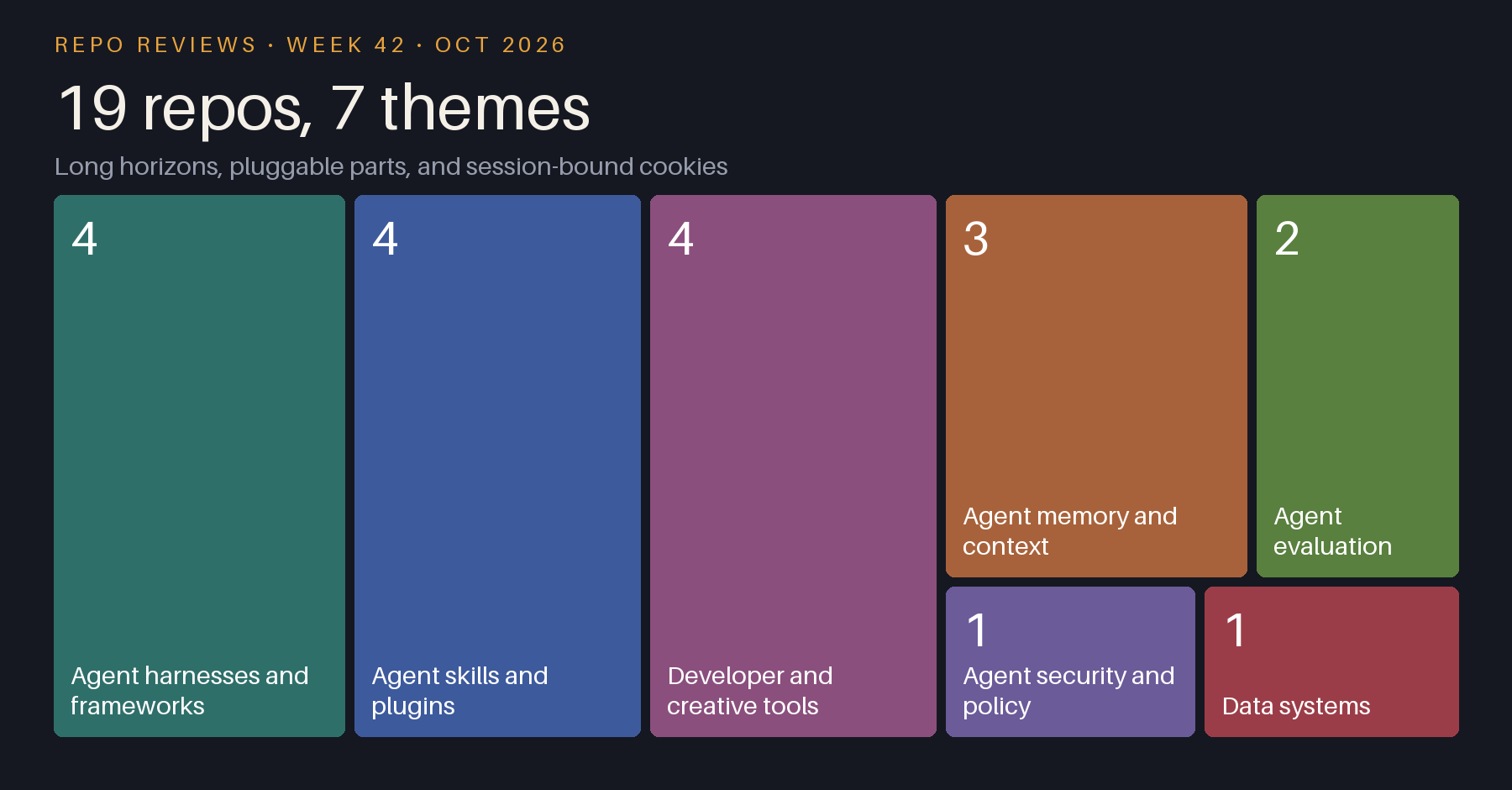
Three threads ran through this week’s reviews: how to evaluate agents over long, stateful runs; how to package skills and memory as swappable modules; and how to harden the credential layer those agents depend on. The repos span robot locomotion, prose editing, legal corpora, and slide authoring, but most of them are solving the same underlying problem of keeping a long-running system coherent without letting its context or attack surface grow without bound.
Agent evaluation
ceobench-src runs an LLM agent through a 500-day startup simulation. Consequences are delayed, state is partially observable, and customer behavior is driven by separate LLM simulators. That setup tests planning that compounds over time, which flat QA benchmarks cannot do. php_parkour takes a different angle: it chains motion matching, privileged-state RL teacher training, and depth-sensor student distillation via DAgger to teach a humanoid robot parkour. The three-stage pipeline is itself an implicit benchmark for how well each stage transfers to the next.
Agent harnesses and frameworks
goose ships as a native desktop app, a full CLI, and an embeddable API in one Rust release, with support for 15+ LLM provider backends and 70+ MCP extensions. pi covers similar ground (coding agent CLI, TypeScript SDK, unified LLM API, agent loop, TUI) but deliberately omits sub-agents and plan mode, leaving those gaps for npm- or git-distributed extension packages to fill. feather-train targets knowledge work (documents, spreadsheets, PDFs) and ships two built-in profiles, prod and train, so the same agent loop and tools serve both live work and training rollout collection. singularity structures a personal computing environment as a Bun plugin workspace with Claude memory directories and MCP configuration alongside app plugins, rather than bolted on externally.
Agent memory and context
MEM1 trains a 7B model via reinforcement learning to maintain a compact internal state that merges prior memory with new observations at each turn, instead of appending full conversation history. imprint approaches the same problem in robotics: a pluggable memory encoder (full-attention or recurrent) sits between episode history and an existing VLA policy backbone, trained in two stages that first bootstrap the encoder alone, then adapt it with the policy. edgequake packages the LightRAG graph-retrieval algorithm as a single Rust binary backed only by PostgreSQL, adding multi-tenant auth, a web UI, an MCP server, and versioned migrations.
Agent security and policy
webappsec-dbsc is the W3C Device Bound Session Credentials spec. It moves session refresh into the browser and binds it to a device-held cryptographic key, so a stolen cookie cannot be replayed from another machine. The server only needs changes at the sign-in handler and a dedicated refresh endpoint.
Agent skills and plugins
hermes-official-plugins ships first-party integrations for Hermes Agent (Home Assistant, Spotify, Langfuse, Blender, and others) as independently versioned directories installed at a reviewed catalog pin. A fix to one integration ships without waiting for a Hermes core release. claude-kit pairs a planning-and-delegation skill (savvy-flow) with a UI mod (savvy-progress) that renders a progress bar and agents panel inside Claude Code. compound-writing applies the installable-skill pattern to prose, separating voice rules (VOICE.md) from editorial standards (STYLE.md) and routing work through a context-aware front-door skill rather than a fixed pipeline. claude-code-playground is Anthropic DevRel’s collection of Claude Code hooks, CLAUDE.md files, settings, and launch demos, each shipping the exact prompts and hooks used, plus notes on what failed before the setup worked.
Data systems
open-us-law normalises 5M+ sections of US primary law (state statutes, regulations, court rules, constitutions, AG opinions) across dozens of jurisdictions into a single 27-column Parquet schema with quarterly dated snapshots, scrapers included, free for non-commercial use on Hugging Face.
Developer and creative tools
deckwerk is a cross-platform WYSIWYG slide editor that treats Linux as a first-class authoring platform and bakes in an agent-editing protocol: an AI agent mirrors the live deck folder and writes HTML slides that compile into normal editable objects, with no cloud service involved. karaoke chains AI stem separation, multilingual lyric alignment with Cantonese jyutping and Japanese furigana, and a real-time web queue into a self-hosted pipeline. elide provides a single runtime and toolchain that executes Kotlin, JavaScript, TypeScript, and Python together. memelint applies ASD-STE100 controlled-language rules to the prose embedded in source files, reporting violations by rule number with approved alternatives.