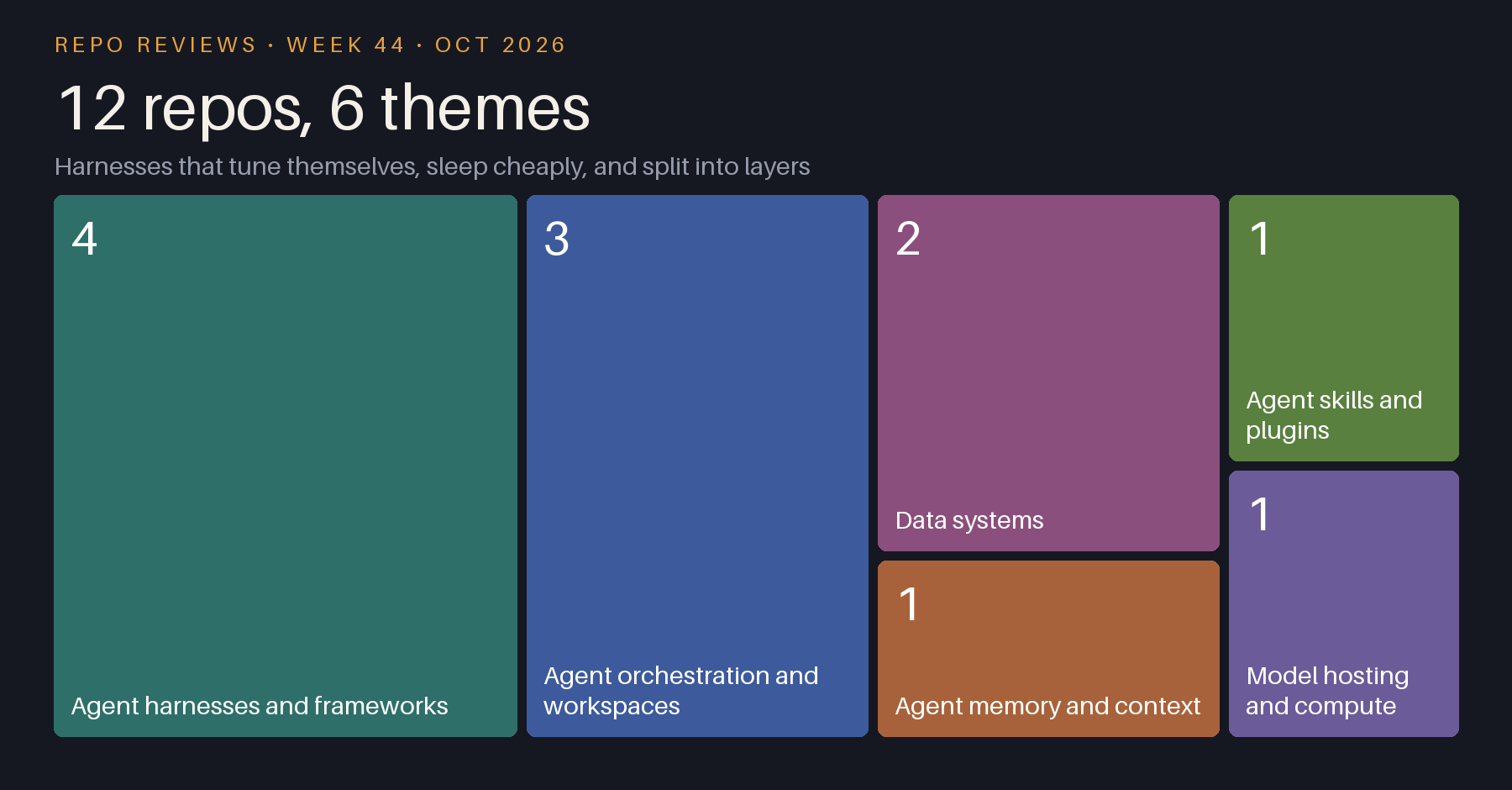
Most of this week’s additions were about running coding agents: how to build the harness around them, how to run several at once, and how to give them memory. The rest were a one-prompt coding skill, two data projects and a video avatar model.
Agent harnesses and frameworks
Four repos added different answers to what a harness should be.
ecosystem-overview is a single README that maps Anima Labs’ Connectome stack in layers: Chronicle storage, Membrane for multi-participant LLM calls, a context-manager and an agent-framework. It also says which of four apps sits on which layer. Its approach differs from clavia-labs/tardigrade, which also builds long-lived agents on an event log: here the store is Chronicle’s branchable one, with undo and redo over inference turns.
equin is a TypeScript platform that pairs an agent harness with a shared plugin system. The author’s own apps (notes, maps, a design tool, a file explorer) reuse the same building blocks, so an improvement to one shows up in the others. It also manages many coding agent sessions in parallel, like superset-sh/superset, but folds that into a larger app platform.
harness2 treats the harness itself as something to optimize. It refines an agent’s prompts, skills and tool guidance for each task while model weights stay fixed. It proposes edits, probes them on the same task, and composes a refined harness from the contrasts, with no ground-truth feedback. It ships with three benchmark setups.
infinity is a Rust runtime where agents run slow tools concurrently and yield while they wait. Between turns an agent is only its conversation history, so a sleeping agent costs nothing until the next event. Its tool protocol delivers results to agents with no running process. Tardigrade keeps an immutable event log, while Infinity keeps just the history. It also pairs the runtime with its own coding agent, Infinity Code.
Agent orchestration and workspaces
Three repos cover running many agents at once, each from a different place.
AutoSwarm installs as a skill inside whichever agent you already use. It then selects, runs in parallel and verifies work across the locally installed agent CLIs, such as Codex, Claude Code and Cursor. Superset orchestrates from a dedicated IDE, and AutoSwarm does the same job from inside an agent you already run.
Agensh has no central orchestrator. Up to 1,024 agents each gather context, claim a sub-task, take action, verify results and merge progress asynchronously. They coordinate through a Gitea workspace, Mattermost messaging and a shared context mechanism.
Paradev is a desktop app that wraps the CLI agent you already pay for (Claude Code, Codex or OpenCode). Each task gets its own Git worktree, terminals, diff viewer and browser preview. A CLI, SDK and MCP server let agents drive it too. Its README still uses the superset name for the CLI binary and release files, and the review notes it as formerly Superset. Compared with Stage-11-Agentics/c11, which multiplexes terminals for agents, Paradev wraps its terminals with worktrees, diff review and an in-app browser.
Agent skills and plugins
ponytail is one prompt built around a ladder the agent climbs before writing code. Does it need to exist? Is it already in the codebase? Does the standard library or a native platform feature do it? Only then write the minimum that works, and leave one small test behind for logic.
Agent memory and context
hindsight is a memory server with retain, recall and reflect calls and Python, Node and Go clients. It sorts memory into world facts, experiences, observations and mental models. A background process consolidates stored facts into evidence-backed beliefs instead of leaving a flat pile. Its README says it addresses the shortcomings of RAG and knowledge-graph approaches, and it merges four retrieval strategies. volcengine/OpenViking also gives agents persistent memory, but Hindsight’s structure is the facts, observations and mental models behind those three calls.
Data systems
opendata builds several Rust databases (buffer, log, timeseries, vector) on one shared object-store storage layer, SlateDB, with one set of operational tooling.
mlx-geospatial runs point-in-polygon queries, spatial joins and great-circle distances on the Apple silicon GPU through MLX. Results can come back as MLX arrays to feed a model directly, and there is an sjoin for GeoDataFrames.
Model hosting and compute
video-diffusion-avatars is research code that turns one portrait photo and a driving video into an animated head you can view from a chosen camera path. It builds on WAN2.2-Animate-14B and adds expression and camera control through a small adapter. A distilled 4-step student streams videos of any length.