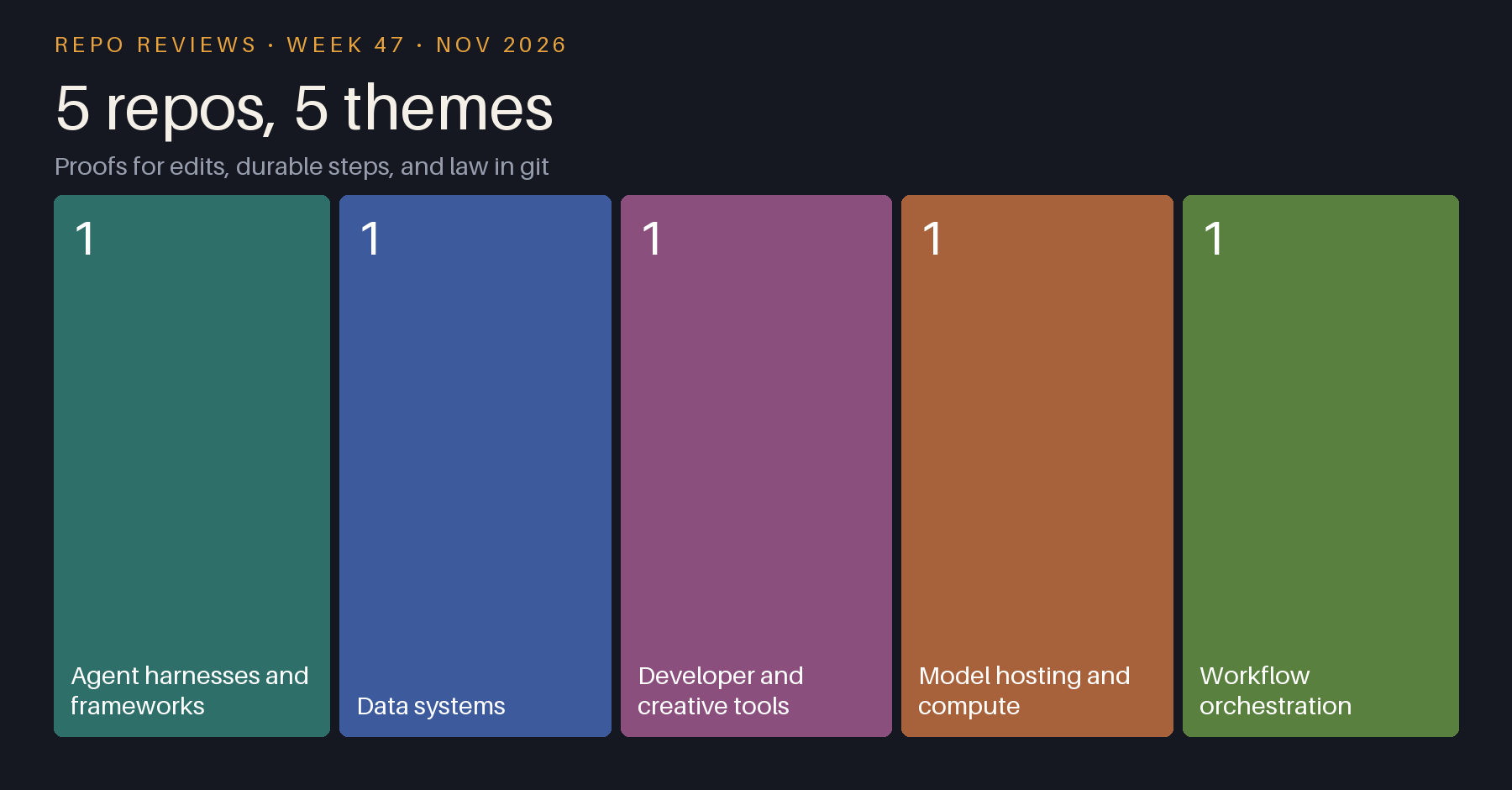
Week 47 brought a language that checks agent edits against written rules, a platform for running many agent sessions, a voice model that remembers the whole conversation, a durable step-function engine, and a collection of laws kept as git history.
Developer and creative tools
bend is Bend 2, a Python-like language with dependent types. It code compiles to C, CUDA, Metal or JS. What it adds here is a LAWS.bend file of rules that lives in the repo. The compiler demands a proof that every edit keeps those rules, and agents write those proofs. It has 25,431 stars and is written in TypeScript.
Agent harnesses and frameworks
equin treats the harness as a platform for building large apps, on top of Claude. It has an agent manager for dozens of parallel sessions, background agents that fix and push updates, and a plugin system of reusable feature blocks. It is small, at 15 stars. Its brief carries the same description and README text as Conchylicultor/singularity, so treat the two as related.
Model hosting and compute
vui is a small conversation-aware text-to-speech model with 219M active parameters. It also comes with a real-time voice assistant and voice cloning. It decodes each spoken reply from a KV cache that holds the whole dialogue, including the audio of your turn. It also ships a pure-C CPU build with no Python, PyTorch or ONNX at runtime. It has 782 stars.
Workflow orchestration
inngest is a durable workflow engine written in Go. You write step functions in code. A server holds the queues, scheduling and run state, and calls your own functions over HTTPS. Each step.run call in ordinary code is retried and checkpointed, and you do not run worker infrastructure. It has 6,048 stars.
Data systems
global-law stores each body of law as its own git repository, with one commit per law taking effect. The repositories are joined as submodules. Python tools and an MCP server answer by in-force date, so you can read a provision as it stood on a given day. It has 2,105 stars.